 A Higher Loyalty: Truth, Lies, and Leadership
 by
James Comey
My rating:
4 of 5 stars
The true takeaway from this book is that leadership is hard. Leaders have to make decisions between duelling worst-case scenarios, and they have to accept the probability of being misunderstood.
James Comey's book explains a lot about how his experiences as a lawyer and prosecutor led him to the decisions he made in the run-up to the 2016 election. Early experiences with organized crime taught him that some leaders value loyalty above all else. Other experiences, like his battles over surveillance techniques and targets, taught him that people are complicated, and that agendas can influence even the most celebrated leaders.
Reading the last part of this book, the part in which he explains his decisions about the Clinton e-mail investigations, led me to a greater **understanding and respect** for what he did. I understand now that we still do not know all of the factors surrounding all of the players in the Justice Department, the FBI, and the political circus we all experienced. We can judge, if we wish, based on our familiarity with the facts as they have been reported, but our judgments are going to be based on incomplete evidence. I fear that will not change, because some of what Comey tells us about the existence of still-classified materials is not likely to change anytime soon. And, perhaps, it's not relevant. We'll never know.
Recommended.
** I say "understanding and respect," not "agreement." I may never agree, or disagree. I do hope I'll never have to see so many competing influences colliding in a presidential election again - foreign interference, tribalism, polarization, disregard for norms, deafness to the concerns of those whose views differ from our own, unrealistic expectations, disregard for prior standards that kept our way of electing our president relatively stable for 250 years. It was hideous.
View all my reviews
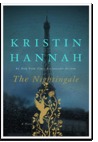 The Nightingale
 by
Kristin Hannah
My rating:
5 of 5 stars
Kristin Hannah begins her tale in 1995, as an ailing, elderly woman tells her son that she will not be parted from a steamer trunk that has stood, unopened, for half a century. He believes it contains mundane mementos that can be repacked into a more compact container. He is wrong. Her son loves her, thinks the old woman, but the dependable, ordinary woman he knows has many secrets.
In 1939, two sisters in France live very different lives. Vianne Mauriac's husband Antoine has just been mobilized. She and their daughter, Sophie, remain in quiet Carriveau. Meanwhile, Vianne's younger sister, Isabelle Rossignol, has been expelled from yet another school in Paris. She briefly works for her father's bookstore, but is forced to flee Paris when the Maginot Line breaks. Along with masses of frightened Parisiennes, Isabelle gets the first hint of the suffering France will endure under the Nazi occupation.
The clashes between the sisters began in their childhood, when their mother died and their father withdrew into alcohol. Even the war does not soften the antagonism between them. Vianne's first concern is the safety of her daughter. She refuses to go along with Isabelle's call to rebel. Vianne believes that the Vichy government will keep them safe, but her hopes shatter one by one.
When the German officer who billets at her home, Beck, informs her that Antoine has been captured, Vianne begins to realize that there are levels of collaboration. Is it wrong for her to cook Beck's meals in exchange for antibiotics, or news from Antoine? Isabelle leaves the village to become a freedom fighter, risking her life to ensure the safety and victory of the Allies.
And what of the old woman? She accepts an invitation to go to paris and attend a ceremony. She is dying, but her son will learn the truth about his family.
Every character, every scene, every flash of history in this novel is a clear look at realities: war, love, courage, and compromise. Vianne and Isabelle embody the experiences and choices that everyday people have to face in wartime. Kristin Hannah has given us a look at the courageous women whose actions may be less-known than those of the heroic men, but who were no less courageous and important.
I received this book from GoodReads in exchange for an honest review. Thank you!
View all my reviews
 That Summer by Lauren Willig
My rating: 5 of 5 stars
That Summer by Lauren Willig
My rating: 5 of 5 stars
It's rare when a novelist can present two timelines that are both fully-realized. Lauren Willig accomplishes this - and more - in her stories about a Pre-Raphaelite painter and his love, and an antiques dealer and his love. I was so enthralled by the Pre-Raphaelite painter's story that I wished Gavin were as real as Rosetti.
Gavin's Imogen, an unhappily-married woman, was in a situation much like that of Dorothea in Middlemarch: married to an intellectual whose work she had longed to share. In the present, both Julia and Nicholas have issues to work through while investigating obscure Pre-Raphaelite paintings found in the house she has inherited.
The stories mesh and veer, as stories do, in a novel that is totally satisfying and engrossing, despite the centuries or geography that divide the reader from them. Highly, highly recommended!
View all my reviews
 The White Magic Five & Dime by Steve Hockensmith
My rating: 4 of 5 stars
The White Magic Five & Dime by Steve Hockensmith
My rating: 4 of 5 stars
Athena Passalis, Tarot reader and con artist, has been murdered, found brutally strangled in her Arizona establishment by her teenaged assistant. Although Athena's daughter Alanis has been estranged from her mother for many years, Athena has willed everything to her, including the White Magic Five & Dime.
At first, Alanis assumes that her mother's shady dealings have caught up with her, that Tarot-reading was merely the last of her mother's many schemes to pry money from gullible souls in this Sedona-Lite town. Not all is as it seems, though, and Alanis decides to take on her mother's last career choice to help a delectable police detective find the killer.
Armed with a deck of Tarot cards and a puckish Tarot guidebook (Infinite Roads to Knowing by Miss Chance), Alanis employs imagination, intuition, and the ability to spot "tells" that she learned in her peripatetic childhood, when she, her mother, and Athena's partner comprised a travelling scam circus. Suspects are plentiful. Was it the husband of a woman whom Athena had urged to buy a herd of llamas? The family of an aged woman who had been convinced to let Athena take away her "cursed" jewelry for her own protection? A bumbling bail-bondsman who was ridiculously easy to identify after a threatening phone call?
Miss Chance's book gives Alanis the basics of Tarot meanings along with asides that appeal to her own cynicism. (As in, yes, the symbolism on the cards could seem overblown enough for a Lady Gaga video.) The Hermit, muses Miss Chance, may seem like an isolated crazy in Idaho who writes anti-government screeds in a cabin, but the card-reader still should listen and learn. Likewise the muumuu-wearing Justice, or the Wheel, which might bring treasure, or might bring a winged cow. Listen and learn...
Alanis begins to feel an unaccustomed pleasure in the life of a small town. What am I really doing here? she asks the cards. The 8 of Pentacles hints at the value of learning a useful trade that could benefit a community. Perhaps, she thinks, she could stay and use the Tarot for good instead of for scams.
Yes, Alanis solves her mother's murder. (That fact really isn't a spoiler in a cozy mystery.) The reader is in for an enjoyable beginning to a new mystery series. Recommended. Why only 4 stars? Because this reader guessed two plot points a bit too soon. I chalk it up to the authors' need to establish the who and where, and I forgive. I'll certainly read a sequel.
I received a reader's copy of this book from NetGally. This is a fair and unbiased review.
View all my reviews
 Thrive: The Third Metric to Redefining Success and Creating a Life of Well-Being, Wisdom, and Wonder by Arianna Huffington
My rating: 2 of 5 stars
Thrive: The Third Metric to Redefining Success and Creating a Life of Well-Being, Wisdom, and Wonder by Arianna Huffington
My rating: 2 of 5 stars
This book is a mishmash of pre- and re- digested advice about getting enough sleep, becoming mindful, meditating, and changing one's value system to honor "the third metric": a redefinition of success to include values beyond money and power.
Ms. Huffington spends many pages telling the reader to unplug from digital devices, and then spends as many pages listing and annotating apps to meditate by, unplug by, control one's multi-tasking by, or even do nothing by. **
She praises and damns social media, makes generalizations about what physicists believe about time, and makes enormous generalizations about being guided by one's intuition or inner sense of rightness. (Note: terrorists believe in their sense of rightness, too.) Other generalizations are more annoying. Sorry, I don't buy the idea that sleep is a feminist issue, and I disagree strongly that people do not bond over moments of shared mortality. Our national experience and personal experience belie that assumption.
Much of the book is not this annoying, but so much of it is that the reader almost misses some genuine insights - such as the observation that the algorithms that govern the user's "personalized" experience at sites such as amazon.com provide a very shallow interpretation of who the user is.
Note to Arianna's editor: Metaphors work better if they're not, dare I say, counter-intuitive, or downright wrong. The iceberg did not hit the Titanic. The Titanic hit the iceberg. Just saying.
I received this book as an ARC. This is my honest review.
**Literally. As in, watch this app for 2 minutes if you want to do nothing.
View all my reviews
 Lost Lake by Sarah Addison Allen
My rating: 4 of 5 stars
Lost Lake by Sarah Addison Allen
My rating: 4 of 5 stars
Another lovely story from Sarah Addison Allen!
Highlights:
Lisette: a mute French woman who senses others' emotions "... slipped straight to her as if through mouse holes..."
A woman named Bulahdeen, whose grandmother used to say that old hands make the best food.
A lake described as "a dense round plop of gray-green water surrounded by trees with Spanish moss hanging from their limbs, like the long hair of ladies dipping their heads to sip from the lake."
All this, plus redemption, courage, love charms, food, and a talking alligator...
View all my reviews
One of the reasons I've been negligent about blogging is that I'm finding being retired to be less than a mixed blessing. In fact, I can't really call it a blessing at all. I was very, very focused for many, many years on my career. Its end was earlier than I would have chosen, as I've written here before, and the time since has not been easy, in many ways.
This afternoon, at Barnes & Noble, I helped a woman choose between two sets of flash-cards for her autistic nephew who loves historical facts. It’s the first time I’ve felt truly useful in … awhile. (Yes, it was a bit disconcerting to hear “can someone help me?” being called over the railing into the cafe, but once I saw she wasn’t in need of CPR or a tourniquet, it turned into an opportunity. I hope we chose well.)
Anyway, the one thing I can be counted on to do is read and comment. That the title of my latest read is related to how I feel about the above is pure coincidence.
 Leaving Everything Most Loved by Jacqueline Winspear
My rating: 5 of 5 stars
Leaving Everything Most Loved by Jacqueline Winspear
My rating: 5 of 5 stars
Can one's life be too settled? Maisie Dobbs rejects the comfortable path as she works on two cases. One case, the murder of two Indian women, brings her to think of the role that country served in the lives of her two mentors, Khan and Maurice, and to wonder if she, too, needs to experience a journey out before she can make a choice. Another case brings her back to neighborhoods she would have known as a child, a sharp contrast to her present circumstances. Other people in Maisie's life face choices and dilemmas, and another World War seems inevitable.
This is a slightly darker Maisie, and it left me even more eager to see what choices she makes next. As always, the writing is evocative and clean, and the characters as real as they come.
Highly recommended!
View all my reviews
I've been negligent about blogging. I haven't been negligent about reading, though, and I have (at least) rated some books over at Goodreads. Some knitting has occurred, mostly socks, plus one silvery thing that (I hope) will make one of my friends happy next week.
Spoiler:
I love knitting lace...
Here's a review of the last book I read. It reminds me a little of a Barbara Pym plot gone slightly mad, with touches of the pain of Empire lingering in the hearts of some co-existing with the utterly dense hearts of a dying aristocracy.
 Major Pettigrew's Last Stand by Helen Simonson
My rating: 5 of 5 stars
Major Pettigrew's Last Stand by Helen Simonson
My rating: 5 of 5 stars
I couldn't love this book more if it were made of dark chocolate and I could eat each page after I read it. There are some of the funniest set pieces I ever read - check out the meeting where characters select food and decor for a country-club dinner, and a walk-through of the most decrepit-yet-charming English cottage ever - as well as genuine characters who grow, change, love, and take up residence in your pantheon.
Recommended to -- everyone.
View all my reviews
 The Sweetness at the Bottom of the Pie by Alan Bradley
My rating: 5 of 5 stars
The Sweetness at the Bottom of the Pie by Alan Bradley
My rating: 5 of 5 stars
Flavia, the 11-year-old narrator of this delicious book, speaks as if she were the offspring of Nancy Mitford, Morticia Addams, and Edward Gorey. She is an expert chemist, with poisons her specialty, and she lives in a so-British-that-you-forget-your-own-nationality town... oh, it's too delightful. Don't miss this one!
View all my reviews
 The Blessing by Nancy Mitford
My rating: 5 of 5 stars
The Blessing by Nancy Mitford
My rating: 5 of 5 stars
Witty and wicked and just a tad dated (in the sense of some extreme political incorrectness), The Blessing is Mitford's take on the cultural chasm between France and England after WWII. English flower Grace marries Charles-Edouard, French aristocrat, and raises their son Sigi alone in the English countryside until he comes home after the war in seven years. They move to France, along with Sigi's unhappy Nanny, whose first experience with French cuisine leaves her horrified - "Funny-looking bread, here, too, all crust and holes. I don't know how you'd make a nice bit of damp toast with that" - and yearning for "a nice floury potato."
Once in Paris, Charles-Edouard's old passions flower, including his relationship with long-time lover Albertine, whose gift of spinning aromatic, sensual tales while telling fortunes has kept their once-torrid, now "sentimental" relationship (with the occasional afternoon tryst) alive. Charles-Edouard's affairs, which Grace's French friends encourage her to accept as entertainments no more important than his material collections, prove more than she can endure when she walks into a room on a mansion tour and finds her husband in bed with one of his pretty, young collectibles.
Before that, however, she meets dozens of unforgettable characters, from the French man who thinks English country life is personified in Wuthering Heights, to the insufferable, hectoring American, Hector Dexter, whose marriage to Grace's school friend Caroline forces her to tolerate his take on the British (who have become "frivolous" about homosexuals whom, he believes are all Communists), and American men, none of whom are "pederasts," since they are all full of "strong and lustful, but clean desire."
(Charles-Edouard is chastised by Albertine when he says that he sees "goodness" shining in the eyes of Americans. "That's not goodness," she says, "that's contact lenses.")
Grace takes Sigi and Nanny back to England and meets up with her ex-fiance Hughie, whose affair with Albertine has been thwarted, and who is ready to settle down and marry Grace. She also meets and flirts with the idea of marrying a charismatic, mad director, whose ghoulish, blonde retinue takes a dislike to Grace and vanishes when he decides to stage a version of a political play that features a snarling dog, an old man who sleeps with a pot of gold under his bed, and his son who is married to a Fascist. She fantasizes a marriage to him being like Charles and Mary Lamb, or Jane and Thomas Carlyle "without the liver attacks."
this does not come to pass...
Certain characters maintain their sense and sensibility with humor and pragmatism. Grace's father, Sir Conrad, muses that the English think that French silver is dirty because it does not shine like English silver, not realizing that English and French silver are totally different alloys. Albertine is charmed when Sigi loves her gift of a kaleidoscope so much he wants to sleep with it: "But this child is his father over again... The moment he sees something pretty he wants to take it to bed with him." Tante Regine charms her English hosts by praising Woolworth's and Yardley perfumes.
And Sigi? One of the great comedic monsters, whose preternatural cunning and powers of observation are thwarted ... just ... by the common sense of a nameless French official, precisely the sort of character keeps civilization humming behind the cultural circuses.
Some critics have said this is not A-list Mitford. Maybe not, but it delighted me. Highly, highly recommended!
View all my reviews


